[ EVENT RECAP ]
Open AGI Tea House: Research, Questions, and Conversation in San Francisco
Three research readings, a guest talk from TinyFish, and an afternoon exploring how we understand, improve, and build with AI.
- EVENT DATE
- LOCATION
- San Francisco, United States
- HOSTS
- Sentient Foundation × TinyFish
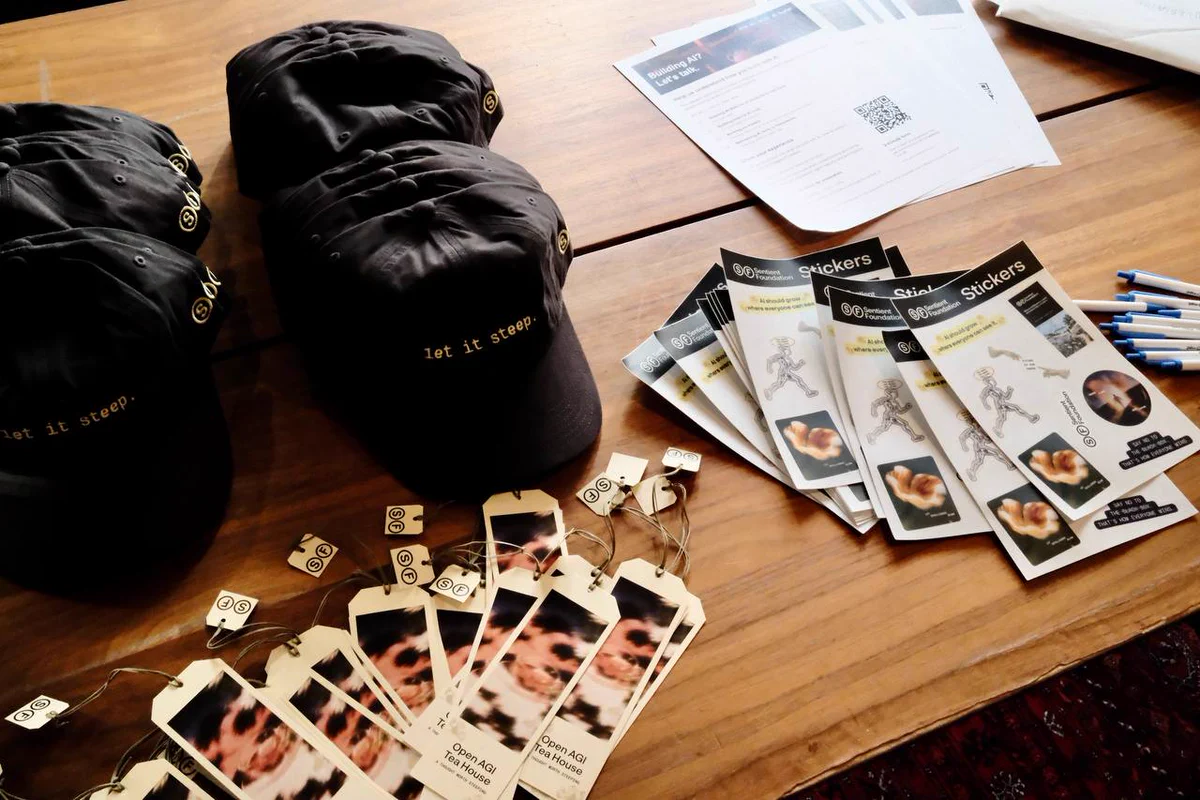
On November 14, 2026, Open AGI Tea House brought researchers, open-source contributors, and AI builders together in San Francisco. Co-hosted by Sentient Foundation and TinyFish, the afternoon made room for paper readings, questions, and conversation over tea.
Sentient researchers Edoardo Contente, Peiyao Sheng, and Dastin Huang led sessions on understanding neural networks, editing model weights, and evolving agent skills. TinyFish’s Adrika Guha connected those research questions to the practical challenge of getting agents to work on the live web.
Reading models: what makes a neuron interpretable?
Edoardo Contente opened the research sessions with “Neural Networks Are Already Clean,” a reading and discussion of Nick Cammarata’s essay. His presentation introduced the ideas behind mechanistic interpretability: how learned features might be represented inside a network, why a neuron can respond to more than one concept, and what it would mean to understand those responses.
The discussion examined whether apparently unrelated features may share a deeper pattern, alongside evidence for sparse and interpretable neuron behaviour. It also kept an important distinction in view: giving a neuron a readable label is a starting point. Testing whether that explanation predicts the model’s behaviour is a stronger check.
Download Edoardo’s presentation (PPTX) [ ↓ ]Editing weights: what can a model really read?
Peiyao Sheng led a critical reading of “Sparks of Weight-Space Programming,” asking what it means for a language model to read, fix, or write the weights of another neural network.
Her presentation separated those three claims. In small networks, a model can sometimes interpret weights when they connect to clearly described inputs, outputs, or familiar circuits. Targeted edits can also repair particular failures. But a successful repair does not establish a general improvement, and translating a known strategy into weights differs from discovering a new strategy.
The session’s questions put evaluation at the centre: who checks the explanation behind an edit, and how do we distinguish understanding a network from recognising a familiar pattern?
Download Peiyao’s presentation (PPTX) [ ↓ ]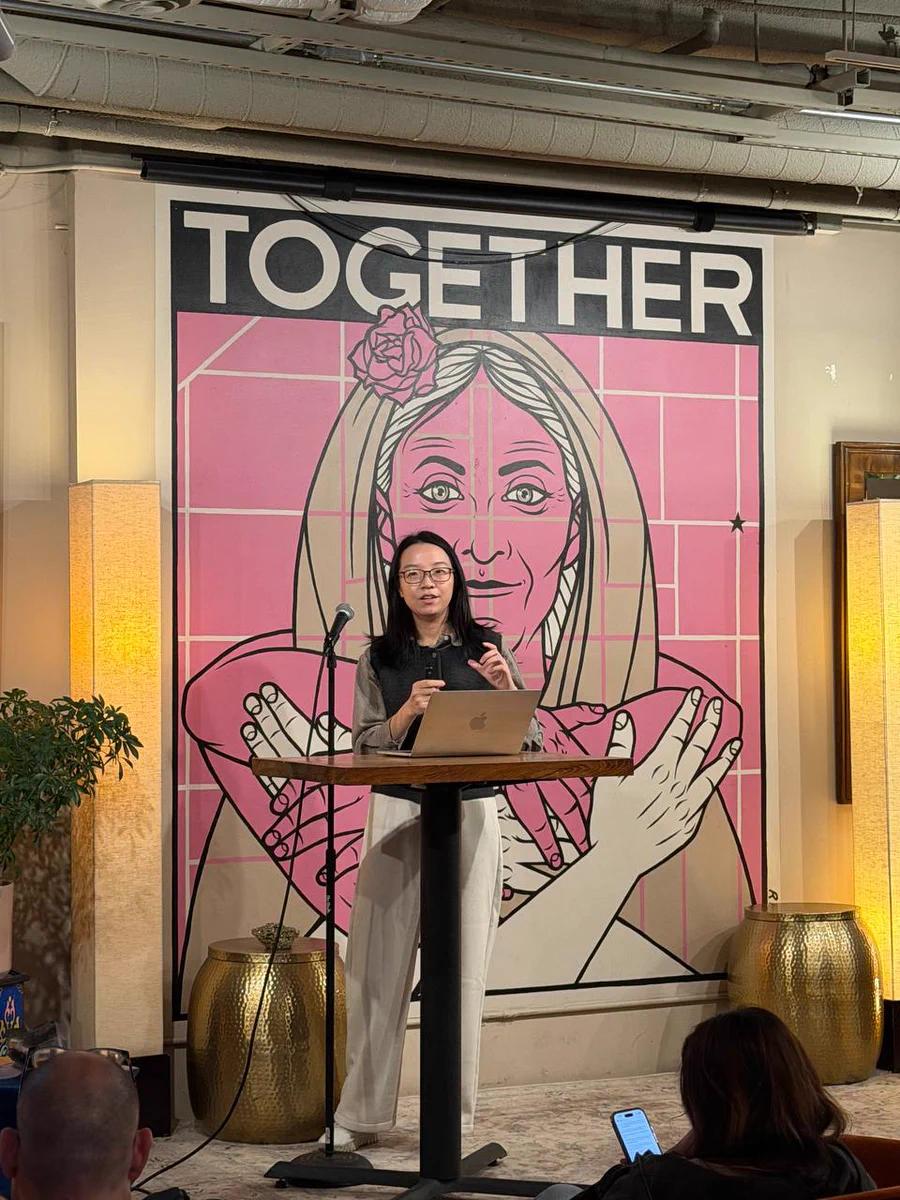
What breaks when agents hit the live web?
After the tea break, Adrika Guha from co-host TinyFish shifted the focus to the environments where agents need to operate. Her talk, “What Breaks When Agents Hit the Live Web,” followed the practical obstacles between finding information and completing a task.
The presentation covered search quality, reading pages rendered with JavaScript, extracting information from PDFs, maintaining authenticated sessions, and navigating multi-step workflows on sites without an API. TinyFish’s examples connected these problems to search, fetch, and browser-agent infrastructure, with attention to reliability and the cost of completing a task.
Download Adrika’s presentation (PPTX) [ ↓ ]EvoSkill v2: learning from an agent’s failures
Dastin Huang closed the talks with EvoSkill v2, showing how agents can improve the skills they use to tackle a benchmark. The starting point was a familiar problem: repeated failures can reveal missing instructions or procedures, even when the underlying model has the capability to succeed.
EvoSkill v2 brings together an adaptor, a solver, and an evolver. The adaptor prepares the benchmark, the solver attempts its tasks, and the evolver examines the results to revise reusable instructions and scripts. A persistent evolution session lets the system build on earlier attempts and reconsider changes.
Dastin’s presentation used spreadsheet and banking tasks to illustrate the approach, while keeping held-out evaluation separate from the development loop. The aim is to turn evidence from failures into better agent behaviour.
Download Dastin’s presentation (PPTX) [ ↓ ]Space to keep the questions going
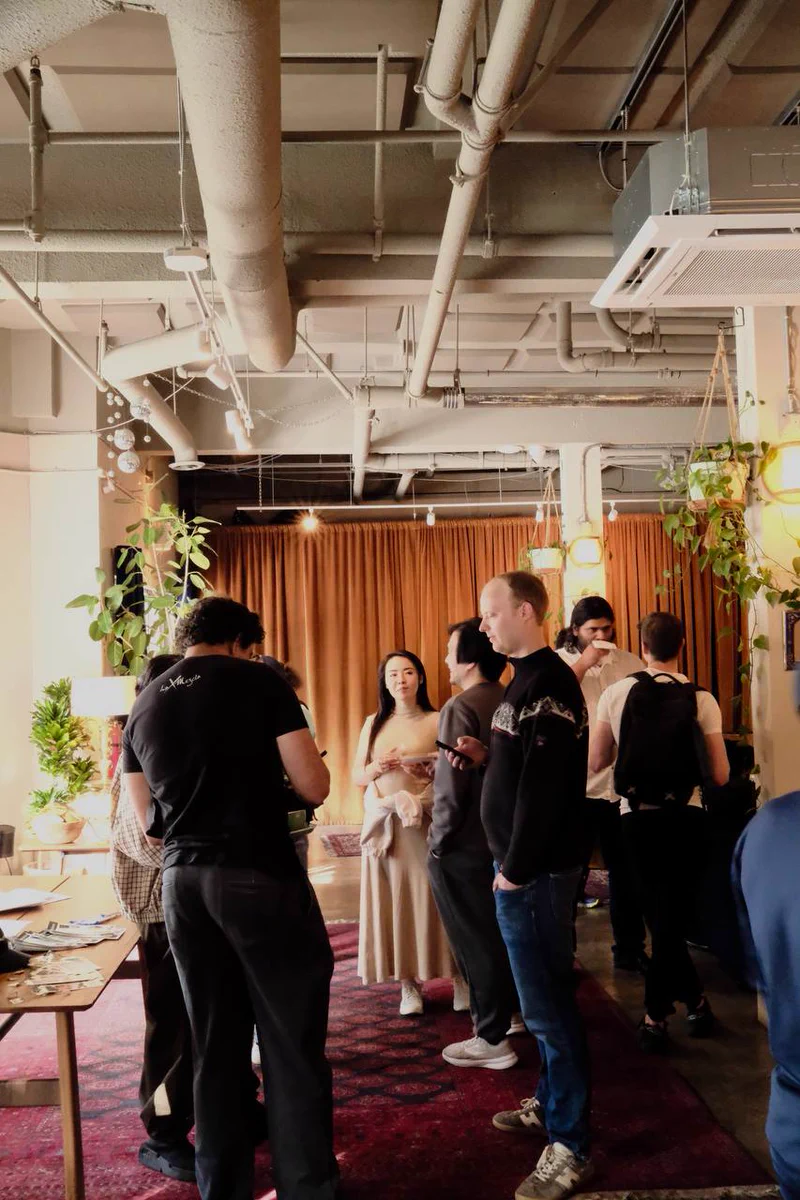
Tea House was designed to leave room around the talks: a tea break between sessions, Q&A with the speakers, and a final stretch for shared questions, table conversations, and board games. The format brought the people reading the papers into the same conversation as the people building with the ideas.
Thank you to Edoardo, Peiyao, Dastin, Adrika, our co-host TinyFish, and everyone who joined us. Explore the presentations above and bring your questions to the next Open AGI gathering.
[ KEEP THE CONVERSATION GOING ]
Be part of what’s next.
Meet the people building open AGI. Join us at an upcoming Open AGI event.
Explore upcoming events